
Does Accurate Geometry Predict the Projected Appearance?
Geometry describes shape. It does not, by itself, establish how a particular finish will look under projected light. The production team also needs to evaluate the surface, ambient lighting and proposed projection setup.
Record More Than the Outline
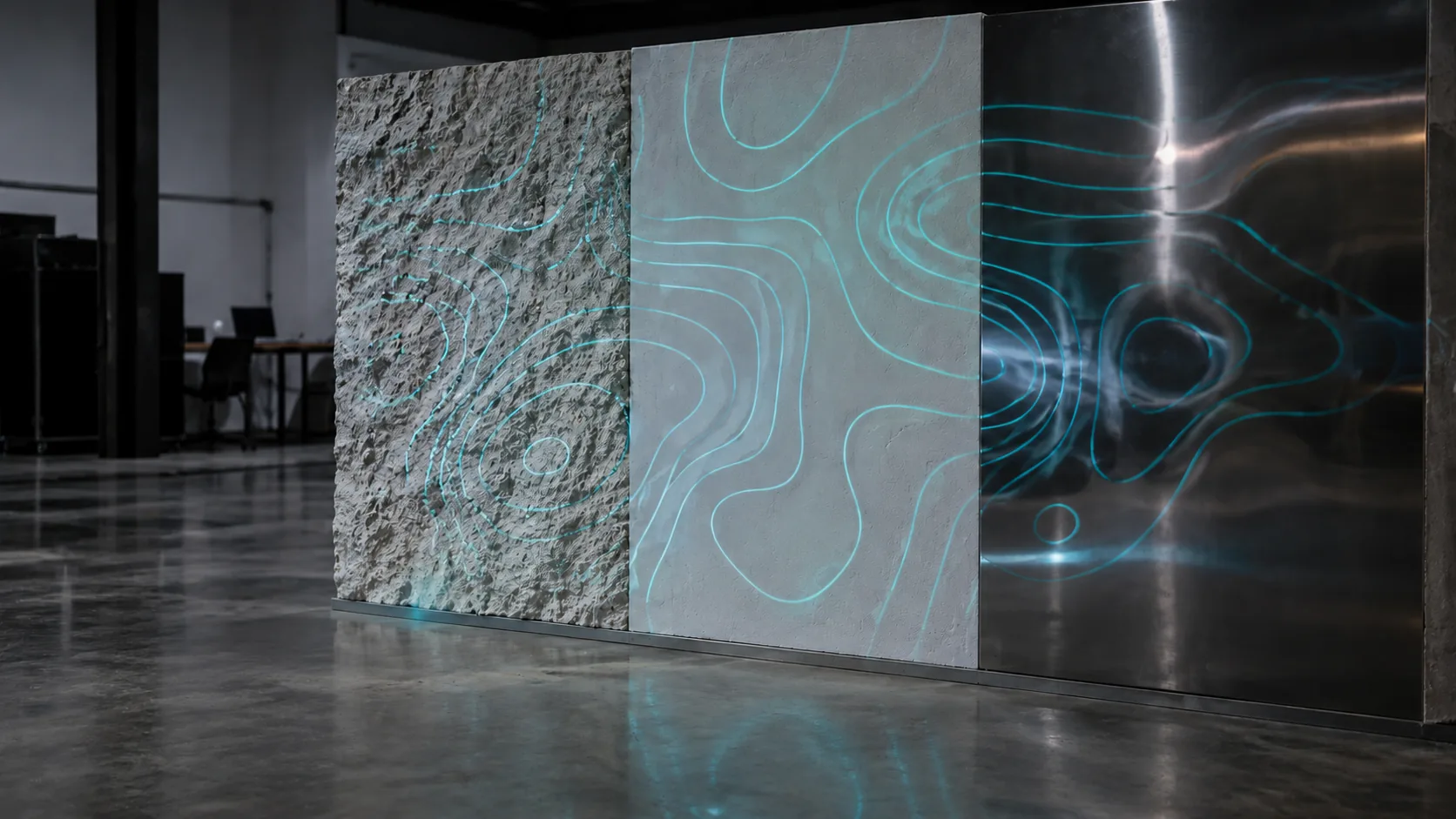
A canvas may combine stone, painted scenic surfaces, metal and glass. Note where materials and finishes change, especially where the creative team expects a continuous image across adjoining areas. Reference photographs and venue information can help the team identify questions for an on-site test.
The cover illustration shows why a shared pattern across different finishes should be reviewed in context. It is an illustrative comparison, not a material specification or a prediction of a particular installation’s brightness.
Bring Capture Questions into the Brief
Tell the capture team about transparent, reflective or unusually dark surfaces and any restrictions on access or temporary markings. Ask how those conditions will be assessed with its chosen equipment. Agree how incomplete or uncertain areas will be reported rather than assuming every finish will produce equivalent data.
- Which finishes are temporary, and which will remain for the show?
- Will scenic repainting or cladding change the canvas after capture?
- Who will review the final material under the proposed light?
Give the AV and Creative Teams a Test Milestone
Reserve time to evaluate the intended media and surface in the actual lighting environment. The production team can then assess image contrast, unwanted reflections, shadows and the viewing experience with its proposed system. Capture supplies a geometric reference for that work; it does not replace the test or calibration.
For a changing scenic set, connect material review to the site and installation schedule. Document the conditions used for review so later changes can be considered deliberately.
Further Reading
Disguise Mapping Matter: planning a projection system in spatial context; our capture planning guide.